
Your agency just delivered a 600-slide brand strategy deck. It cost you five figures, took four months, and three people in your company have actually read it. Two weeks later, the CFO asks which initiatives are moving the revenue needle. You open the deck. The deck doesn't answer that question. The deck never could.
This is the quiet scandal of the brand strategy agency model: the deliverable becomes obsolete the moment it's delivered. Markets shift, your ICP evolves, a competitor repositions, your sales team finds a new angle that actually closes – and the strategy document, which was supposed to guide all of this, sits in a shared drive being slowly forgotten. By the time your next quarterly review rolls around, you're either paying for a refresh or operating from a foundation everyone has stopped trusting.
For decades, the bargain was straightforward. You wanted senior strategic thinking, so you rented it. The agency assembled a team, ran workshops, built frameworks, and handed you a binder. The binder was the artifact. The binder was the value. Whether anyone in your organization could operationalize the binder was a separate concern – usually solved by hiring, hoping, or paying the agency again next year.
That bargain is breaking. Not because agencies got worse. Because the world they were built for moved on.
The three failures of the strategy deliverable
The first failure is temporal. Brand positioning, ICP definitions, and Brand DNA frameworks were treated as durable artifacts – the kind of thing you set once and revisit on a multi-year cycle. That worked when markets moved in years. They now move in weeks. A competitor's funding round, a platform algorithm change, a single viral product launch can reshape who your buyer is and why they care. A static deck cannot keep up. It was never built to.
The second failure is operational. Strategy lives in one document; execution lives in twelve – the marketing plan, the sales playbook, the OKR tracker, the campaign brief, the product roadmap. Each one references the strategy nominally and ignores it functionally. When a marketer at 9am Monday is deciding whether to greenlight a campaign, they don't open the brand positioning deck. They open Slack. The strategy is supposed to be a north star, but in the gravity well of daily decisions, it's invisible.
The third failure is intellectual. The agency model assumes that strategy is a creative output – a one-time act of brilliant pattern recognition delivered by senior consultants. But after twelve years of running the same diagnostic conversations across hundreds of companies, the brilliant pattern recognition starts looking less like art and more like a process. The questions are repeatable. The frameworks are repeatable. What's not repeatable is the context: your business, your market, your live data. And context is precisely what the deck strips out the moment it's printed.
What strategy actually needs to be
If you set the agency model aside for a moment and ask what brand and growth strategy actually needs to do for a company, the answer comes out very differently.
It needs to be a living foundation, not a document. Positioning, ICP, and Brand DNA need to update when the underlying reality updates – not on an annual cycle, but continuously, as evidence accumulates from sales calls, product usage, and market movement.
It needs to be operational. Every initiative your team runs should connect, visibly, to the strategic outcome it's supposed to drive. When that connection breaks – when a campaign or feature is consuming budget without moving the needle – the system should surface it before the quarterly review, not after.
It needs to be available to the people doing the work. The CMO doesn't need the strategy. The marketer planning Tuesday's campaign needs the strategy, in a form that answers their actual question: should I run this, given what we stand for and where we're trying to go?
None of this looks like an agency engagement. All of it looks like a system.
Where cosmos™ fits
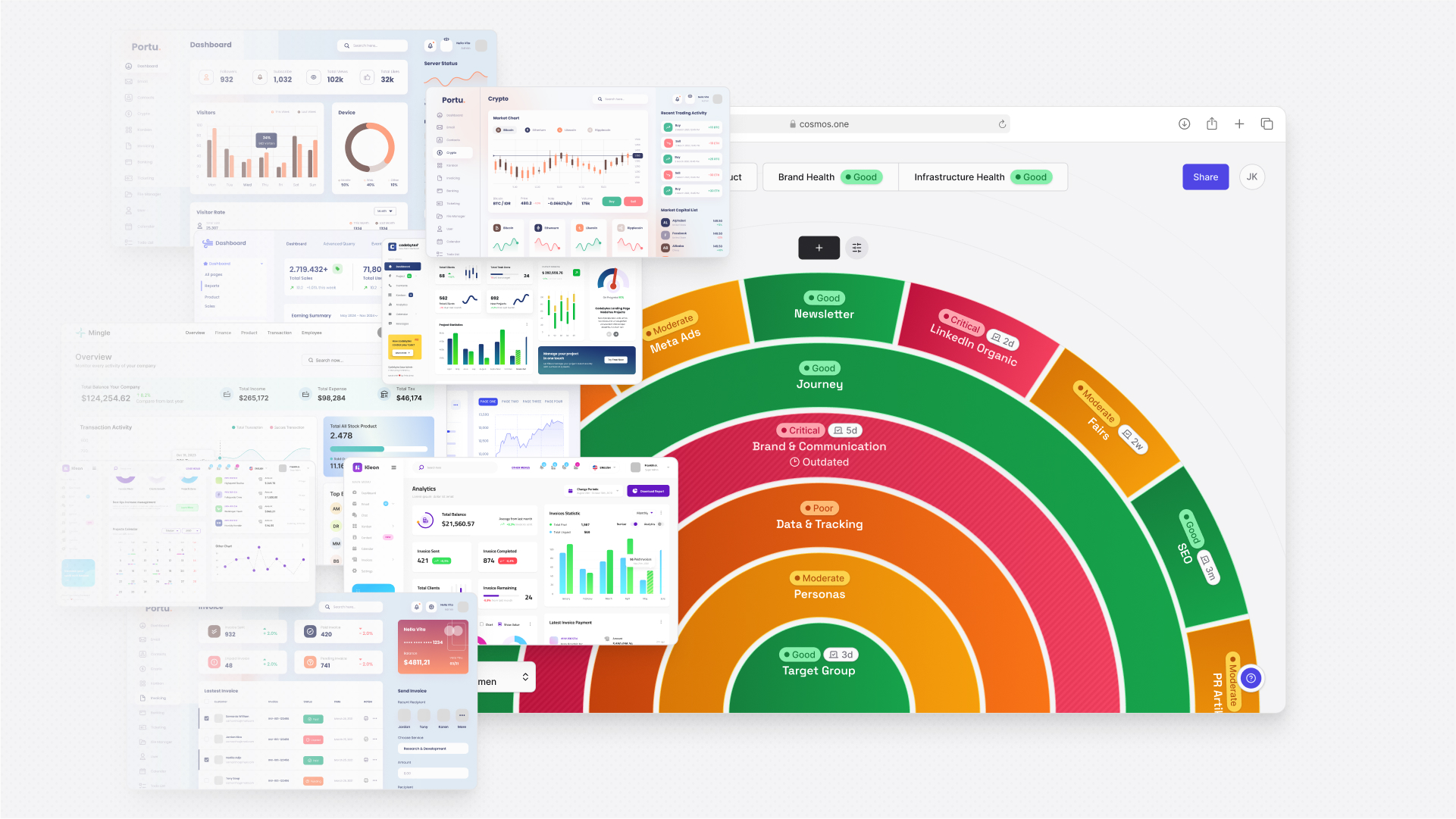
This is the gap cosmos™ closes. cosmos™ is the AI-native Growth Strategy Platform – a brand strategy tool that replaces the standard output of a strategy agency with twelve years of brand and growth strategy work digitized into a platform that runs continuously inside your organization.
The strategic foundation – Positioning, Brand DNA, ICP, business model – lives as a structured, living layer rather than a deck. It's built once with proven frameworks and then maintained by the people who actually run the business. Goals connect down into initiatives through impact chains, so the question "did this campaign move the goal" is no longer a quarterly autopsy but a real-time read. And the Growth Strategy AI sits on top of all of it, answering strategic questions in your specific context – your positioning, your KPIs, your personas – instead of giving the generic responses you'd get from a chat tool that has never seen your business.
The economic shift is the part most leaders underestimate. A full deployment of cosmos™ runs at a fraction of a single brand strategy consultancy engagement, and it doesn't disappear when the project ends. The intelligence stays. The system runs.
Find out more in this article.
The shift that's already happening
The leaders making this transition aren't doing it because they hate agencies. Many of them came from agencies, or still use them for specific creative work where outside perspective genuinely earns its fee. They're moving because they've watched too many decks die in shared drives and decided that the strategic core of their company shouldn't be something they rent. It should be something they own – and something that works on Monday morning, not just at the offsite.
Owning your strategy used to mean hiring a Chief Strategy Officer and three analysts. Now it means running it on a platform that knows your business, updates with your reality, and is operational from day one.
The deck era is ending. What comes after isn't another agency.
Ready to see how it works? Book a call with our team.

